


Understanding the Psychology of Finance: Why People Make Irrational Money Decisions
Contents show
Views: 108
Introduction
Financial systems are often designed based on the assumption that participants act as “rational actors” – individuals who consistently make decisions that maximize their utility based on all available information. However, human behavior frequently contradicts this model. From impulsive purchases to holding onto declining assets, irrationality is a fundamental characteristic of how humans interact with money.
This article explores the psychological mechanisms, cognitive biases, and external factors that lead to irrational financial choices, providing an educational overview of how the human mind processes value and risk.
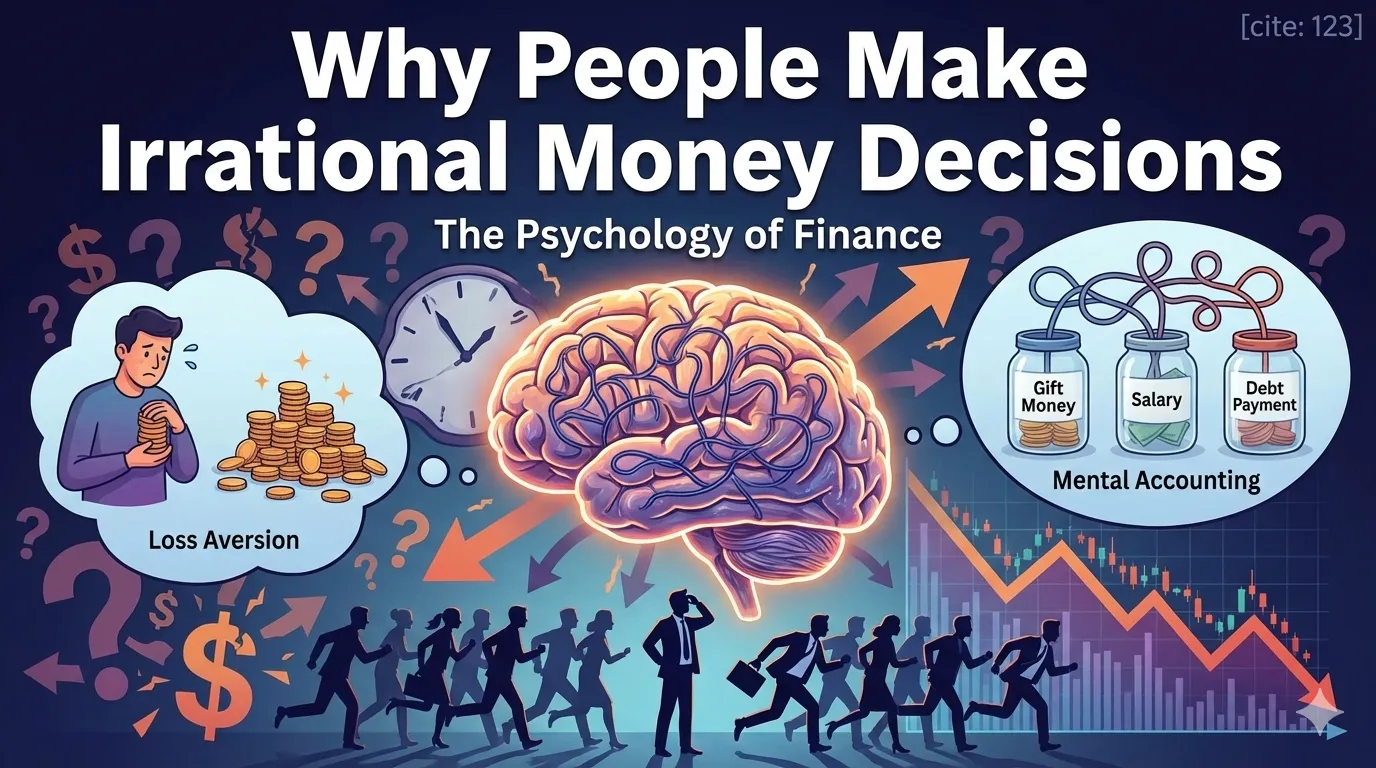
The Biological Foundation: The Brain vs. Modern Currency
To understand irrationality, one must first look at the biological evolution of the human brain. The structures responsible for decision-making were developed long before the invention of digital banking, credit scores, or complex stock markets.
The Role of the Limbic System
The limbic system, often referred to as the “emotional brain,” is responsible for immediate survival instincts. When individuals encounter financial stress or a perceived “limited-time offer,” this part of the brain may take over. It prioritizes immediate gratification and safety over long-term strategic planning.
The Prefrontal Cortex and Cognitive Load
The prefrontal cortex is the area of the brain responsible for complex planning and rational thought. However, this system requires significant energy and focus. When a person is tired, stressed, or overwhelmed by too many choices—a phenomenon known as “decision fatigue”—the prefrontal cortex may defer to simpler, more impulsive emotional responses.
Core Cognitive Biases in Finance
Psychologists and behavioral economists have identified specific patterns of deviation from rationality, known as cognitive biases. These shortcuts help the brain process information quickly but often lead to systematic errors in financial judgment.
1. Loss Aversion
Research suggests that the pain of losing $100 is often twice as intense as the joy of gaining $100. This asymmetry, known as loss aversion, can lead to several irrational behaviors:
-
Holding Losing Positions: An individual might refuse to sell a declining investment because doing so “finalizes” the loss, even if the capital could be better used elsewhere.
-
Excessive Risk Avoidance: The fear of potential loss may prevent individuals from participating in necessary financial growth activities, such as long-term retirement planning.
2. Anchoring and Adjustment
Anchoring occurs when an individual relies too heavily on the first piece of information encountered (the “anchor”) when making decisions.
-
Example: If a product is marked as “Reduced from $1,000 to $600,” the consumer may view $600 as a bargain based on the anchor of $1,000, regardless of whether the item is actually worth $600 in the current market.
3. Mental Accounting
This bias involves treating money differently based on its source or intended use. While all currency has the same purchasing power, people often categorize it into “buckets”.
-
Found Money: Someone might spend a tax refund or a gift more frivolously than money earned through their monthly salary.
-
Debt vs. Savings: An individual may keep money in a low-interest savings account while simultaneously carrying high-interest credit card debt, failing to see the net financial loss.
Emotional Triggers and Financial Choices
Money is rarely just a numbers game; it is deeply intertwined with self-worth, security, and social status.
The Impact of Financial Stress
When individuals operate under high levels of financial stress, their cognitive bandwidth is reduced. This “scarcity mindset” often leads to a focus on immediate needs at the expense of long-term stability, potentially resulting in a cycle of high-interest borrowing or missed payments.
Herd Behavior and Social Proof
Humans are social creatures who often look to the behavior of others to determine their own actions. In finance, this manifests as “herd behavior”:
-
Market Bubbles: When people see others making quick gains in a specific asset, they may feel compelled to join in due to Fear of Missing Out (FOMO), often entering at the peak of the market.
-
Lifestyle Creep: Observing the spending habits of peers can lead to “conspicuous consumption,” where individuals spend money they do not have to maintain a specific social image.
Systematic Factors and Choice Architecture
Irrationality is not solely an internal failing; the way financial products are presented—known as “choice architecture”—influences how decisions are made.
The Friction of Payment Methods
The physical sensation of giving away cash provides a “pain of paying” that helps regulate spending. Modern digital and contactless payments remove this friction, making it easier to spend impulsively because the loss of value feels less tangible.
Comparison of Rational vs. Irrational Financial Behaviors
| Scenario | Rational Approach | Irrational/Biased Approach |
| Windfall (e.g., Bonus) | Evaluate against current debt and long-term goals. | Immediate “treat” or luxury purchase (Mental Accounting). |
| Market Downturn | Review long-term strategy and risk tolerance. | Panic selling to avoid immediate pain (Loss Aversion). |
| Subscription Services | Regular audit of utility vs. cost. | Ignoring small monthly fees due to “low” perceived impact |
| Credit Card Usage | Paying balance in full to avoid interest. | Paying only the minimum because it feels “cheaper” today. |
Risks, Limitations, and Trade-offs
Acknowledging irrationality is the first step toward building more resilient financial habits. However, it is important to understand the trade-offs involved in trying to achieve “perfect” rationality.
-
The Cost of Analysis: Attempting to analyze every single financial decision perfectly can lead to “analysis paralysis,” where no decision is made at all.
-
Subjectivity of Value: What seems irrational to an outside observer may have significant emotional or psychological value to the individual.
-
Systemic Barriers: Sometimes, what looks like an irrational choice is the only available option in a system with limited access to traditional banking.
For more foundational information on managing these factors, you may visit our Psychology Hub or read our guide on How Loans Really Work.
Irrationality in financial decision-making is not a sign of low intelligence; it is a byproduct of how the human brain is wired to process risk, reward, and social standing. By understanding biases like loss aversion, anchoring, and the effects of financial stress, individuals can become more aware of the “invisible” forces influencing their choices. While complete rationality may be an impossible standard, awareness of these psychological patterns allows for a more grounded understanding of how money moves through our lives and societies.
FAQ
Is it possible to completely eliminate cognitive biases in finance?
Why do I feel the urge to spend more when I use a credit card?
Why do people continue to invest in things that are clearly losing value?
Does financial education stop irrational behavior?
Author

Financial Editor & Credit Analyst
Areas of expertise:
Payday loans and short-term credit
Installment loan structures
APR, fees, and penalties
State-level lending regulations
Borrower risk analysis
Michael Turner is a financial editor and credit analyst specializing in consumer lending in the United States. He has over 8 years of experience analyzing payday loans, installment loans, and alternative credit products.
His work focuses on real borrowing costs, APR calculations, penalties, rollover conditions, and borrower risk scenarios. Michael reviews loan offers across different U.S. states with attention to regulatory disclosures and consumer protection.
Areas of expertise:
Payday loans and short-term credit
Installment loan structures
APR, fees, and penalties
State-level lending regulations
Borrower risk analysis
Language: English
Region focus: United States